User research has always been one of the most valuable inputs in product development. Interviews, observations, surveys, usability tests, support conversations, and field studies can reveal what people need, where they struggle, and what opportunities a product team may be missing.
The challenge is not necessarily collecting this information. It is making sense of it.
As research programs become more extensive, product teams can end up with hundreds of pages of transcripts, recordings, survey responses, notes, images, and observations. Important patterns can be difficult to see when information is scattered across different sources and stakeholders.
AI-driven research synthesis offers a way to organize that complexity. Used appropriately, AI can help product teams identify patterns across large volumes of qualitative and quantitative research, compare different user perspectives, and turn raw findings into clearer design questions.
But AI should not replace the research process or the judgment of experienced designers. Its greatest value is helping teams move more efficiently from information to insight, and from insight to action.
What Is AI-Driven User Research Synthesis?
User research synthesis is the process of reviewing research findings and identifying the patterns, behaviors, needs, frustrations, and opportunities that should influence product development.
Traditionally, this may involve manually reviewing interview transcripts, highlighting observations, organizing sticky notes, creating affinity maps, and discussing themes with a cross-functional team.
AI can assist with many of these activities.
Depending on the research and tools involved, AI can help teams:
- Organize large volumes of research data
- Identify recurring themes and patterns
- Group similar user comments or behaviors
- Compare feedback across different user groups
- Summarize interviews and observations
- Identify potential contradictions or outliers
- Extract recurring pain points
- Help transform findings into research questions or design requirements
The important distinction is that AI helps accelerate synthesis; it does not determine what a product should be.
The designer still needs to understand context, evaluate evidence, recognize nuance, and determine which findings actually matter to the product and business.
Why Synthesis Matters More for Physical Products
Research synthesis is important for any product, but physical products introduce additional layers of complexity.
A user’s experience with a physical product can involve ergonomics, environment, workflow, maintenance, safety, accessibility, materials, controls, storage, cleaning, and many other factors.
A single interview might reveal that a user dislikes a product’s handle. That observation alone is not necessarily a design requirement.
Additional research may reveal that the problem is not the handle itself. Perhaps users have to hold the product at an awkward angle, use it repeatedly throughout the day, wear gloves while operating it, or clean it between uses.
The value of synthesis is finding the relationship between those observations.
AI can help surface connections across research that would be difficult to identify manually, particularly when teams are working with large datasets. But those connections still need to be interpreted within the real-world context in which the product is used.
From Raw Research to Actionable Insights
The goal of synthesis is not to produce a shorter version of the research.
It is to produce information that can influence decisions.
A useful synthesis process can move through several stages:
Research data → Patterns → Insights → Design implications → Product decisions
For example, multiple users might describe difficulty operating a device with one hand. AI-assisted analysis could identify that this issue appears repeatedly across interviews and usability observations.
A designer can then investigate the underlying context.
Is the problem related to grip strength? Reach? Button placement? Product weight? The sequence of operations?
That distinction matters.
A research summary might say:
Users have difficulty operating the product with one hand.
An actionable insight goes further:
Users need to stabilize the product while simultaneously accessing the primary control, creating unnecessary hand repositioning during repeated tasks.
The second finding is much more useful to a product team because it points toward a design opportunity.
Look for Patterns, Not Just Frequency
One of the risks of AI-assisted synthesis is assuming that the most frequently mentioned issue is automatically the most important.
Frequency can be useful, but it is only one dimension of research.
A relatively uncommon observation may reveal a serious safety concern. An issue mentioned by only a few expert users may expose a workflow problem that affects an entire product category. A seemingly minor frustration may become significant when it occurs repeatedly during a high-frequency task.
AI can help identify frequency and relationships between observations, but designers need to evaluate the importance, context, and consequences of each finding.
This is especially important for physical products where a user’s environment can dramatically change how a product is experienced.
The best synthesis combines what appears often with what matters most.
Connect Different Types of Research
Another advantage of AI-assisted synthesis is the ability to work across different research formats.
Physical product teams may collect information from:
- User interviews
- Field observations
- Usability testing
- Surveys
- Customer reviews
- Support requests
- Competitive research
- Market research
- Internal stakeholder interviews
- Product performance data
Each source provides a different perspective.
Customer reviews may reveal recurring frustrations. Interviews can explain why those frustrations occur. Observational research can reveal behaviors users may not mention themselves. Usability testing can show where an interaction breaks down.
When these sources are analyzed together, teams can develop a more complete understanding of the problem.
The objective is not to treat every source as equally reliable or interchangeable. Instead, synthesis helps teams see where evidence converges—and where it does not.
Turning AI Insights Into Physical Design Decisions
Research becomes valuable when it changes what the team does next.
Once meaningful patterns have been identified, designers can translate them into product requirements, design principles, concepts, or areas for prototyping.
For example, research synthesis might reveal that users struggle with a product because:
- The primary control is difficult to identify.
- The product requires excessive grip force.
- Cleaning interrupts the normal workflow.
- Users cannot easily see whether an operation has been completed.
- Different users approach the same task in different ways.
These findings can influence decisions about form, controls, ergonomics, materials, interfaces, and product architecture.
The important step is maintaining a clear connection between the research evidence and the resulting design decision.
AI should make that connection easier to explore—not obscure it.
Midmark Dental: Where Research Complexity Matters
A strong example of the type of physical product development that benefits from disciplined research synthesis is CHOI Design Group’s work with Midmark Dental.
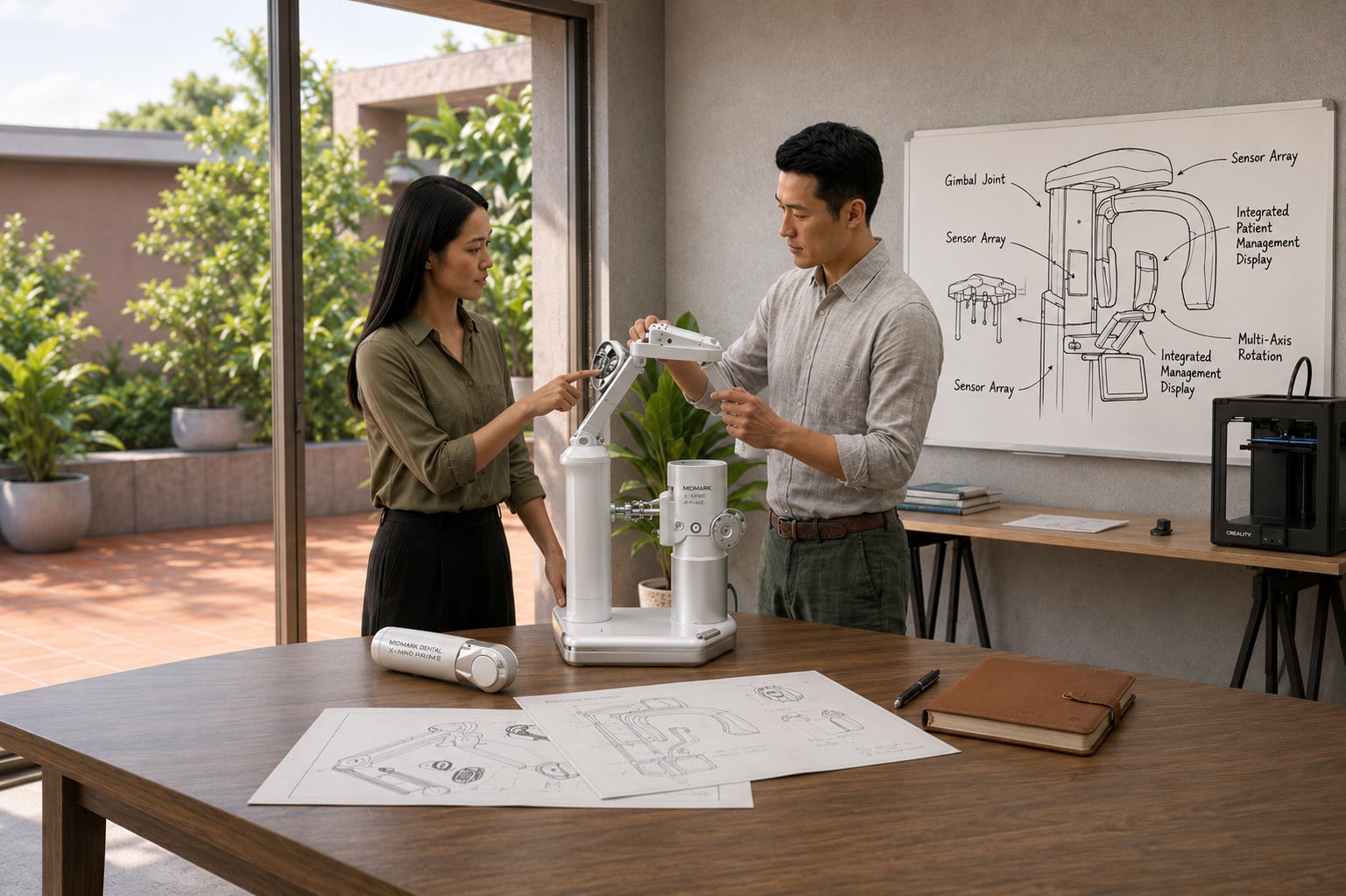
CHOI Design Group worked with Midmark to create a new flagship dental X-ray machine, with the project involving usability, ergonomics, and the interaction between clinicians and complex medical equipment. CHOI’s work on the project reflects the broader challenge of designing products around real clinical workflows rather than treating the physical form as an isolated design problem.

For a product used in a professional healthcare environment, research can produce many different types of observations. A clinician may focus on workflow efficiency, while another user may prioritize physical interaction, maintenance, or ease of operation.
The value of synthesis is bringing these perspectives together and identifying the underlying design priorities.
The Midmark project was not an AI-driven research project, and it should not be presented as one. Instead, it is a useful example of the type of complex physical product environment where rigorous research synthesis can help designers distinguish individual comments from broader patterns and translate those patterns into meaningful design decisions.
This distinction is important. AI is an emerging tool that can support the synthesis process; the underlying principles of observing users, understanding context, and applying professional design judgment remain fundamental to CHOI Design Group’s approach.
AI Should Support Designers, Not Replace Them
The most effective use of AI in research synthesis is collaborative.
AI is particularly useful for handling repetitive analytical tasks, but it can miss the significance of context, body language, environmental factors, or contradictions within user behavior.
For physical product development, those details matter.
A user might say that a product is “easy to use” while repeatedly changing their grip during a task. An interview participant might describe what they believe they do, while observation reveals what they actually do.
Experienced researchers and designers can recognize these differences. AI can help organize the evidence, but human interpretation remains essential.
Teams should also consider privacy, confidentiality, data quality, and the limitations of the AI tools being used. Sensitive research data should be handled according to appropriate organizational and client requirements.
Build a Better Decision-Making Loop
AI-driven synthesis is most valuable when it becomes part of an iterative design process rather than a one-time research exercise.
A practical workflow might look like this:
- Collect — Gather interviews, observations, testing results, and other relevant research.
- Structure — Organize the information so different sources can be compared.
- Synthesize — Use AI to help identify themes, relationships, and recurring observations.
- Validate — Review the findings against the original research and investigate unexpected patterns.
- Interpret — Apply design expertise and real-world context to determine what the findings mean.
- Design — Translate insights into requirements, concepts, and prototypes.
- Test — Put those concepts back in front of users and generate new evidence.
This creates a continuous feedback loop between research and design.
Instead of treating research as a report that gets handed to designers and forgotten, teams can use it as an active input throughout product development.
Better Synthesis Can Lead to Better Product Decisions
AI does not make user research more valuable simply by making it faster.
Its real potential lies in helping teams work with more information without losing sight of the decisions that information needs to support.
For physical products, that means moving beyond generic observations and identifying the specific behaviors, constraints, and unmet needs that should influence the design.
The strongest product development teams will likely be those that combine the scale and speed of AI with the curiosity, empathy, and critical judgment of experienced researchers and designers.
That combination can help teams identify meaningful opportunities earlier, test ideas more effectively, and make design decisions with greater confidence.
CHOI Design Group brings research, industrial design, prototyping, and engineering together to help teams turn user needs into products that work in the real world. If you’re exploring how AI and emerging research tools can strengthen your next physical product development program, contact CHOI Design Group to start the conversation.